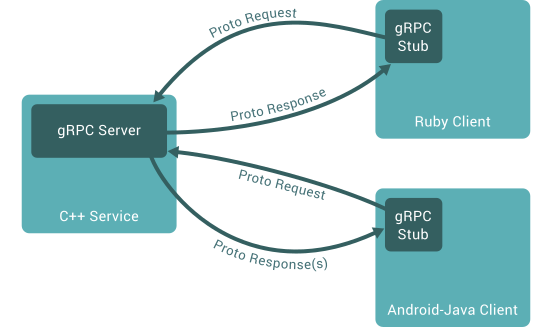
At the core of gRPC, you need to define the messages and services using Protocol Buffers. The rest of the gRPC code will be generated for you and you’ll have to provide and implementatin for it. one .proto file works for over 12 programming languages (server and client), and allow you to use a framework that scales to millions of RPC per seconds.
- gRPC is a
freeandopen-sourceframework developed by Google - gRPC is part of the Cloud Native Computation Foundation (CNCF) - like Docker & Kubernetes for example
- At a high level, it allows you to define REQUEST and RESPONSE for RPC (Remote Procedure Calls) and handles all the rest for you
- On top of it, it’s
modern,fast and efficient, build on top ofHTTP/2,low latency, supportsstreaming,language independent, and makes it supper easy to plug inauthentication,load balancing,loggingandmonitoring.
What’s an RPC?
- It’s not a new concept (CORBA had this berore).
- With gRPC, it’s implemented very cleanly and solves a lot of problems.
Protocol Buffers?
- gRPC use Protocol Buffers for communications.
- Let’s measure the payload size vs JSON:
// JSON: 55 bytes
{
	"age": 25,
	"first_name": "Younhghyun",
	"last_name": "Ahn"
}

// same in Protocol BUffers: 20 bytes
message Person {
	int32 age = 1;
	string first_name = 2;
	string last_name = 3;
}
We save in Network Bandwidth.
Efficiency of Protocol Buffers over JSON
- Parsing JSON is actually CPU intensive (because toe format is human readable)
- Parsing Protocol Buffers (binary format) is less CPU intensive because it’s closer to how a machine represents data
- By using gRPC, the use of Protocol Buffers means
fasterand moreeffcientcommunication, friendly with mobile device that have a slower CPU
Summary: Why Protocol Buffers?
- Easy to write message definition
- The definition of the API is independent from the implementation
- A huge amount of code can be generated, in andy language, from a simpe .proto file
- The payload is binary, therefor very efficient to send / receive on a network and serialize / de-serializer on a CPU
- Protocol Buffers defines rules to make an API evolve without breaking existing clients, with is helpful for microservices
Language Interoperability
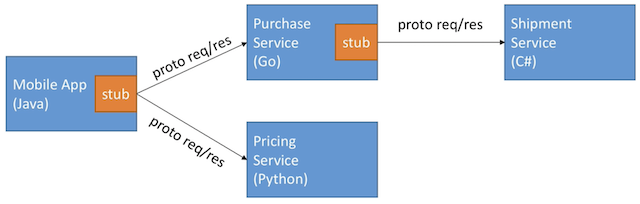
gRPC can be used by any language. Because the code can be generated for any language, it makes it super simple to create micro-services in any language that interact with each other.
4 Types of API in gRPC
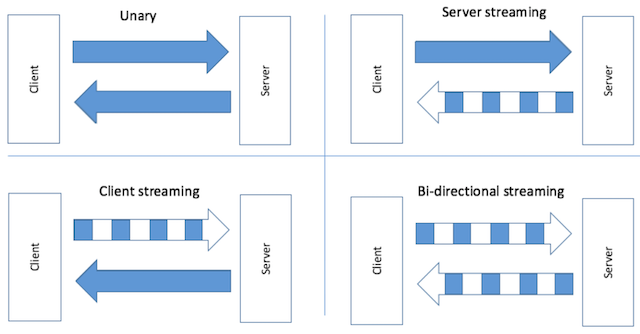
- Unary is what a traditional API looks like (HTTP REST)
- HTTP/2 enables APIs to now have streaming capabilities.
- The server and client can push multiple messages as part of one request!
- In gRPC it’s very easy to define thes APIs as we’ll see
Scalability in gRPC
- gRPC Server are asynchronous by default
- This means they do not block threads on request
-
Therefore each gRPC server can serve millions of requests in parallel
- gRPC Clients can be asynchronous or synchronous (blocking)
- The client decides which model works best for the performance nees
- gRPC Client can perform client side load balancing
gRPC vs REST
| gRPC | REST |
|---|---|
| Protocol Buffers - smaller, faster | JSON - text based, slower, bigger |
| HTTP/2 (lower latency) - from 2015 | HTTP1.1 (high latency) - from 1997 |
| Bidirectional & Async | Client => Server requests only |
| Stream Support | Request / Response support only |
| API Oriented-“WHAT” (no constraints - free design) | CRUD Oriented (Create-Retrieve-Update-Delete / POST GET PUT DELETE) |
| Code Generation through Protocol Buffers in any language - 1st class citizen | Code generation through OpenAPI / Swagger(add-on) - 2nd class citizen |
| RPC Based - gRPC does the plumbing for us | HTTP verbs based - we have to write the plumbing or use a 3rd party library |
Summary: Why use gRPC
- Easy code defiition in over 11 languages
- Uses a mordern, low latency HTTP/2 transport mechanism
- SSL Security is built in
- Support for streaming APIs for maximum performance
- gRPC is API oriented, insted of Resource Oriented like REST
Check out the gRPC and gRPC Reflection, REST v. gRPC for more info.